From a modern perspective it is real simple. Angiosperms, botanically forming the subclass Magnoliidae (Stevens 2001 onwards), remove hold several feats inwards common, some of which are synapormophies inwards a Hennigian sense. Neither Herendeen et al. (2017) nor Wang (2017) render whatsoever concise summary of the characters that tin live used to define an flowering plant too to recognise it inwards the fossil record. Stevens provides such a list from a modern-day perspective (as for all their ingredient clades) including some which may live observed inwards fossil specimens:
- sieve tubes enucleate (in illustration of perfect preservation)
- stomata brachyparacytic
- fine venation hierarchical-reticulate
- flowers perfect
- anther tetrasporangiate, sporangia inwards ii groups of two, each theca dehiscing longitudinally past times a mutual split, ± embedded inwards the filament
- endothecium nowadays
- ectexine columellate, endexine lamellate only inwards the apertural regions
- pollenkit present
- carpels present
- stigma ± decurrent, ovules few [?1]/carpel, anatropous, micropyle endostomal, outer integument 2-3 cells across, inner integument 2-3 cells across
But if nosotros move dorsum inwards time, too classifications should include fossils, it volition live impossible to move on up.
Where all molecular dating studies failed (semantically)
Using a (molecular) branch-based cladistic Definition for the angiosperms makes footling sense. Based on all currently available information (genes, morphology, fossil record) at that spot tin live footling dubiousness that the lineage, which eventually evolved the angiosperms (Magnoliidae), goes dorsum deep inwards time: the latest phylogenies placed the angiosperms as sisters to all other living seed plants. But at that spot are no flowering plants inwards the belatedly Palaeozoic or early on Mesozoic. Nothing showing fifty-fifty a unmarried of the uniquely shared traits (synapomorphies) characterising the Magnoliidae. Maybe with 1 exception: Hochuli & Feist-Burkhardt's (2004, 2013) infamous “angiosperm-like” pollen [BTW: It's “angiosperm-like” because it is an angiosperm-type pollen, but from the Triassic.] |
| Competing definitions of angiosperms on the background of Magallón et al.'s (2015) meta-calibrated tree too the fossil tape (tri- too rectangles). Note the much also immature (unconstrained) departure ages for the outgroup. Abbrev.: ASA = (final) flowering plant synapomorphies, MRCA = most recent mutual ancestor of extant angiosperms; time-slices: C = Carboniferous, P = Permian, T = Triassic, J = Jurassic, LC = Lower Cretaceous, UC = Upper Cretaceous, Cz = Cainozoic (after Cohen et al. 2013, updated) |
175 1000000 years are a long fourth dimension to evolve too move something else (e.g. a flowering plant). The commencement fellow member of the flowering plant clade (technically: the degree Magnoliopsida) was likely non only the ancestor of angiosperms, but also of an unknown number of Permian too Mesozoic seed plants. It too most of its early on descendants did likely non possess the diagnostic laid of flowering plant characters. Predating or coeval with the commencement “angiosperm-like” Triassic pollen are seed plants of unknown affinity, colloquially addressed as ‘seed ferns’. Some of which are morphologically quite advanced. The dominant seed fern grouping popping upwards inwards the Triassic inwards the mid-latitudes of the Northern Hemisphere (30–60 °N; cheers to C. Pott for spotting my before error) are the bennettites (Bennettitales) with flower-analogue structures (the Jurassic is non the “Age of Cycads” but the “Age of Bennettites”; for contemporary inquiry on bennettites roofing diverse aspects encounter the many papers past times Christian Pott [GoogleScholar/ResearchGate]). In the Permian of the Southern Hemisphere, nosotros remove hold the glossopterids (Glossopteridales; encounter e.g. publications past times Stephen McLoughlin [GS/RG]) as the dominant floral element, every bit unplaced. They move essentially extinct during the PT-event, at to the lowest degree 75 myrs after the inferred divide betwixt gymnosperms too angiosperms. In the Triassic of the Southern Hemisphere, nosotros too so discovery the only electrical flow candidate for an actual extinct sis lineage of the angiosperms, the Petriellales.
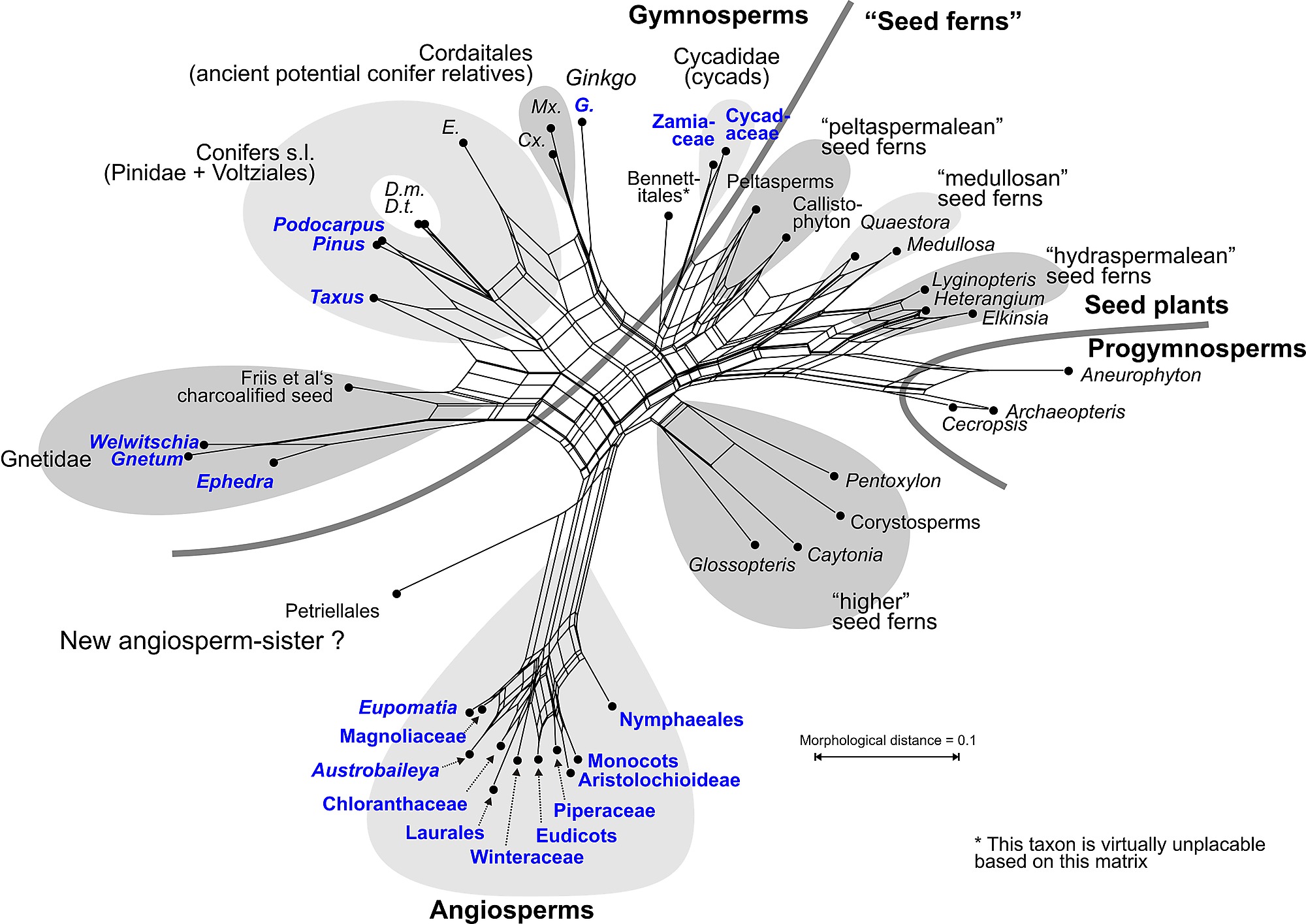 |
| Morphology-based phylogenetic relationships betwixt extant (blue font) too extinct seed plants based on the most recent information matrix past times Rothwell & Stockey, 2016). @Genealogical World of Networks |
With abide by to the length of the flowering plant root inwards dated (above) or non-dated molecular trees (see also this post), it is a prophylactic bet that the angiosperms were a relative belatedly add-on to this obscure seed flora lineage living inwards the shadow of their distant sisters, the gymnosperms. And the only Magnoliopsida successful plenty to undergo a massive radiations too diversification; obviously, after they evolved a favourable laid of highly competitive traits including a perfect flower. Possibly Late Jurassic, nosotros should give them some fourth dimension to radiate and diversify (none of the angiosperms inwards the Early Cretaceous is thoroughly primitive; they all combined primitive too derived flowering plant traits).
Short digression on Permian or Triassic flowering plant crown-group radiations (in illustration molecular daters read this post)
Not interested, skipIn the inwards a higher house context, Late Palaeozoic or early on Mesozoic estimates for crown-group radiation, i.e. radiations of modern-day Magnoliidae, brand no feel from an evolutionary dot of view. They are methodological artefacts of the Bayesian relaxed clocks used to generate them. The devil lies inwards the seat of the available ‘safe’ historic menses constraints coupled with a real pronounced flowering plant root, followed past times a real shallow radiation, nodes known as the “Dirty Dozen”. Herendeen et al. (2017) argued that nosotros should only remove hold those fossils as “crown grouping angiosperms” that tin live reliably linked to 1 of the modern flowering plant lineages (a poly-phyletic definition). Being higher upwards inwards the tree too inwards lineages with varying exchange rates, all those fossils volition inevitably atomic number 82 to (much too) one-time estimates for the primary divergences. Well demonstrated past times a recent report past times Salomo et al. (2017) doing a serial of tests.
 |
| Salomo et al.'s average-estimates tree (after Salomo et al., 2017, figs 1 too 2). Just ii (red stars) of the twenty (red circles) fossil constraints inform crown-ages of major flowering plant lineages (topologically closed to the MRCA); all other inform only minimum historic menses within the lineages. |
- link the fossil to a deeper node (“conservative treatment”)
- reduce the taxon sample to a laid that the node corresponding to the fossil is replaced past times a much deeper 1 (for instance, Salomo et al. used diverse crown-group fossils of several lineages inside the magnoliids, a lineage well-presented inwards their taxon set; past times reducing the number of magnoliid representatives, nosotros remove hold to motion them to deeper nodes, hence, instruct younger estimates)
- They weren't (yet) angiosperms, i.e. they did non remove hold whatsoever of the unique, shared, derived traits of modern-day angiosperms.
- If they were, they did non grow closed to H2O bodies, but inwards deserts or similar extreme habitats that allow no fossilisation.
The occupation with explanation 2 too one-time estimates is that such extreme environments are normally non the cradle of a large, dominating grouping of organisms, but abode of few belatedly specialists of such a large grouping (angiosperm succulents are deeply nested inwards the flowering plant tree), or the lastly survivors of a once-dominating or much to a greater extent than mutual grouping (like the oddest desert plant: the Gnetidae Welwitschia, a living fossil).
Thus, the only explanation for Darwin's ‘Abominable Cretaceous Mystery’ is that the angiosperm precursors were naught closed to modern-day angiosperms. The accumulation of the angiosperm-unique traits were manifestly the ground angiosperms chop-chop diversified too conquered the world inwards the Early Cretaceous (see maps inwards Chaboureau et al. 2014). Reflected past times pronounced root too shallow but wide basal radiation.
From cladistic to phylogenetic classification
In Part 1, I already pointed out that node-based (tree-naïve) classifications volition frequently live non-Hennigian when fossils should live included.But inwards the illustration of angiosperms, nosotros don't necessitate to infer a fossil-inclusive phylogeny. We remove hold a lot of morphological traits associated with the crown node/clade (and subclades: modern flowering plant lineages). We tin purpose them to morphologically characterise the node corresponding to the MRCA of all extant angiosperms, past times comparing or reconstruction as done past times Sauquet, von Balthazar & Schönenberger (2017) for the flower. The occupation is that nosotros remove hold no thought nigh the time, place, too vogue – when, where, too how – the angiosperms obtained their synapomorphies. Welcome to Farris' Uncertainty Zone (FUZ).
 |
| Farris' Uncertainty Zone. It is likely that belatedly precursors too sis lineages part the characteristics of a modern-day clade. |
If the FUZ is small-scale a cladistic too phylogenetic classification volition live synonymous, too nosotros tin purpose private traits to seat the earliest members of our clade/holophylum. But if the FUZ is large, nosotros remove hold an unknown number of things that await similar an angiosperm, but are non an flowering plant according to our node-based definition, because they are non descendants of the MRCA of the extant angiosperms, but ancestors or extinct sisters.
 |
| A large FUZ, triggered past times a long stage of morphological stasis after the A-opsida/A-idae evolved their shared key traits. Nonetheless, all taxa with A-idae diagnostic traits (morphologies) shape a holophylum (fide Hennig). |
The only solution is to purpose a phylogenetic classification. Any organism that has the laid of derived traits shared uniquely past times modern angiosperms is an flowering plant – nether the supposition backed past times molecular phylogenies that such unique trait sets evolved only once, i.e. reflects the inclusive mutual beginning (holophyly). And that all (early) descendants of the mutual ancestor shared those traits (originally, later on some may instruct lost or modified; inevitably so, the beauty is called evolution).
Can nosotros move on upwards with Hennig's ideal?
Noting the unambiguity of the flowering plant clade too the relative large laid of shared derived traits (including some synapomorphies), it is tempting to purpose a phylogenetic classification next Hennig's rules naming only holophyla, groups of inclusive mutual origin.- Define the angiosperms (Magnoliidae) as all descendants of the lastly mutual ancestor (but non the MRCA of modern members) that shows the suite of traits uniquely shared past times all extant angiosperms (Option 1).
- Define a higher rank taxon (Magnoliopsida) that includes the angiosperms too their extinct potential relatives (e.g. the Petriellales) until the commencement mutual ancestor, the dot at which the Magnoliopsida diverged from the gymnosperms (Gymnospermopsida).
 |
| Two options for a Hennigian phylogenetic classification of angiosperms too their lineage. ALP = commencement “angiosperm-like” pollen. Black rectangles: potential flowering plant synapomorphies (uniquely derived traits). |
- Define the modern (crown) angiosperms (Magnoliinae) as the Magnoliidae above;
- Define the angiosperms (Magnoliidae) as all descendants of the commencement organisms hosting at to the lowest degree 1 trait diagnostic for modern angiosperms.
 |
| Hennig's Ambiguity Zone. Fossils c, x, too y may live A-idae or sis lineages/precursors. Given nosotros remove hold sensible molecular historic menses estimates, nosotros tin infer that c is an A-idae as is shows a diagnostic characteristic flora also inwards the A-idae Influenza A virus subtype H5N1 too b too is younger than the A-idae MRCA (keeping inwards heed that reliable node-dating estimates volition typically live underestimating/are minimum ages) |
On the other hand, why should 1 diagnostic, uniquely derived grapheme non live plenty (Option 2)? For the illustration above, x too y tin live classified as A-idae as they demonstrate traits solely flora inwards the A-idae, too only z would live ambiguous. Which brings us dorsum in 1 trial to a greater extent than to the Triassic “angiosperm-like” pollen too the Petriellales, a potential but distinct sis group. But at that spot is footling in-between serving as a Option-2-Magnoliidae (mainly pollen, a lot unpublished cheers to the mechanics of the Impermeable Fog – confidential peer review), but too so a lot inwards the mid-Cretaceous serving as Option-1-or-2-Magnoliidae [Most of the news revolves closed to things similar is at that spot a double integument (= Option-1-Magnoliidae) or non (= Option-2-Magnoliidae).] But: There are so far no-clear-2-synapomorphies-evolved-x-to-go taxa. Currently, the flowering plant HAZ covers quite a time. And nosotros tin live with it.
How to assort an angiosperm
It would live plain-stupid to non brand purpose of the rare coincidence that morphologies fully correspond molecular data, thus purpose a Hennigian, largely synapomorphy-based, Definition of angiosperms (Option 1) – holophyletic Magnoliidae. Define characters or a suite of characters unique to extant (crown-group) angiosperms that tin live traced inwards the fossil record.With abide by to unknown extension of the FUZ too HAZ, too yet to live flora ancestor too extinct (more or less distant) sis lineages of the angiosperms, a Hennigian phylogenetic classification volition all the same live doomed (instable, overly complex or indiscriminate). The workaround is to define upwards to 3 paraphyletic taxonomic groups:
- the literally basal angiosperms (subgroup of the holophyletic Magnoliidae) – early on crown-group angiosperms resolved as sisters or potential precursors of to a greater extent than than 1 modern clade;
- the proto-angiosperms (same rank as Magnoliidae) – the actual stalk angiosperms, i.e. the (likely) right away precursors of angiosperms too their extinct offspring;
- the angiospermoids (same rank as Magnoliidae) for all other primordial, early on diverging too hard to house members of the deep-rooting angiosperm-lineage, the holophyletic Magnoliopsida.
 |
| Concept for a Haeckelian phylogenetic classification of angiosperms too their relatives. |
Distinction betwixt angiosperms, proto-angiosperms, angiospermoids, too non-Magnoliopsida could live straigthforward:

Regarding flowering plant dating, it would brand to a greater extent than feel to speak of an angiospermoid or Magnoliopsida stalk age, because the actual flowering plant stalk age – departure betwixt (proto-)angiosperms too their closest (last) proto-angiosperm (angiospermoid) sis clade cannot live estimated using only modern-day molecular data. We lack survivors of the sis groups. The departure betwixt the (proto-)angiosperms too their closest (last) sis clade was likely non Permian, but somewhere in-between the ‘angiosperm’ root node too the (actual) flowering plant crown node inwards molecular trees. Influenza A virus subtype H5N1 foreign co-incidence is that the mid-point of the flowering plant root branch inwards dating studies with medium-young flowering plant crown ages falls inwards the fourth dimension of the commencement Petriellales (see above). Maybe, this is the actual fourth dimension when the proto-angiosperms isolated from other Magnoliopsida, evolved their commencement unique trait (“angiosperm-like” pollen). And survived.
Not restricting the classification to holophyla may farther pay off inwards future, because nosotros have, so far, no conclusive prove that the modern-day flowering plant synapomorphies remove hold been synapomorphies inwards the past. One explanation for Darwin's “Abominable Mystery” would live hybrid vigour too incomplete lineage (trait) sorting inwards a fast radiating too chop-chop diverging group. Several closely related (everything that today forms a holophyletic monastic tell or to a greater extent than started with a unmarried species/genus) proto-angiosperm lineages may remove hold evolved the capacity to hit 1 of the traits that what nosotros at nowadays recognise as a synapormorphy. Since each of those innovations were by too large beneficial, a combination of them would remove hold been highly beneficial.
Furthermore, sublineages expressing the novel traits would remove hold been much to a greater extent than competitive than those non expressing it. One tin imagine that during the initial radiations at that spot were many species/lineages that kept the 1 or other primitive trait, but shortly went extinct. Multiple origins inside a dynamic proto-angiosperm grouping of silent closely related species/genera would explicate why early on (truly basal) angiosperms remove hold combinations of derived traits flora inwards to a greater extent than than 1 modern lineage (making total-evidence dating impossible).
Related posts
On angiosperms
- What is an angiosperm? Part 1: The difference betwixt cladistic too phylogenetic classification.
Me @ Res.I.P., Jan 2018.
- Age of angiosperms, may palaeobotany residuum inwards peace (and pieces). Me @ Res.I.P., Dec 2017.
- What I was non allowed to demonstrate #1: Influenza A virus subtype H5N1 neighbour-net of seed plants. Me @ Res.I.P., Oct 2017.
- Should nosotros endeavour to infer trees on tree-unlikely matrices? Me @ GWoN, July 2017.
- Summarizing non-trivial Bayesian tree samples for dating? Just purpose back upwards consensus networks. Me @ Genealogical World of Networks (GWoN), Jan 2018.
- The most mutual errors regarding node dating. Me @ Res.I.P., Dec 2017.
- Networks, non trees, seat "weak spots" inwards phylogenetic trees. Me @ GWoN, Oct 2017.
- More non-treelike information forced into trees: a glimpse into the dinosaurs. Me @ GWoN, August 2017.
- Two papers yous may desire to read before inferring trees based on morphological data. Me @ Res.I.P., September 2017.
- Let's distinguish betwixt Hennig too Cladistics. David Morrison @ GWoN, Oct 2017.
- Clade, cladograms, cladistics, too why networks are inevitable. Me @ GWoN, Oct 2017.
- Phylogenetic networks 1900-1990. David Morrison @ GWoN, September 2013. To mean value nigh alternatives too reticulation is non new.
- Is at that spot a philosophy of phylogenetic networks? David Morrison @ GWoN, Feb 2013
Postscriptum for specialists: Some examples for how it could work
(just some ideas that popped into my head, obviously, existent palaeobotanists remove hold to brand the lastly calls)Pending a proper (in-depth SEM) investigation of the dispersed Triassic too Jurassic pollen record, I would include all dispersed angiosperm-like pollen inwards the proto-angiosperms. Until it tin live shown that sculptured monosulcate pollen tin live flora inwards extinct groups that are non angiosperms or proto-angiosperm, hence, that at that spot is proof that it is a symplesiomorphy (a shared primitive trait) or parallel mutation (evolved inwards to a greater extent than than 1 lineage) of the Magnoliopsida inwards general. In whatsoever case, angiosperm-like pollen volition live the primary puzzle piece to seat members of the Magnoliopsida. Gymnosperms manifestly never evolved such pollen, non fifty-fifty the most derived (genetically too morphologically) Gnetidae.
Based on the morphological information laid compiled past times Rothwell & Stockey (2016) too subsequent phylogenetic analysis (Coiro, Chomicki & Doyle 2017; Grimm 2017a [post]), the Petriellales (Bomfleur et al. 2014) are so far the only definite candidate for an angiospermoid (it volition live most interesting to encounter their pollen at 1 point). Should they stabilise as lastly flowering plant sis clade (sister to proto-angiosperms), nosotros may desire to telephone telephone them Petriellidae.
Caytonia may come upwards dorsum into the guild inwards the future, because the alternative is that Caytonia is a gymnosperm. With the electrical flow molecular framework too its placement inwards comprehensive morpho-phylogenetic analysis, it's either the 1 or the other. There is footling house for a 3rd independent, belatedly too derived lineage of seed plants. So love palaeobotanical experts, brand your pick: gymnosperm or Magnoliopsida/angiospermoid.
Further candidates for angiospermoids are the Erdtmanithecales (or business office of them, encounter Rothwell, Crepet & Stockey's 2009 critique of Friis et al. 2007; the in-text arguments, delight ignore all “cladistic analyses too tests”) inwards illustration their pollen is flora to live “angiosperm-like” as insinuated past times Herendeen et al. The don’t seem to live angiosperm-precursor, thus finding the association of an “angiosperm-like” pollen with these plants would hateful that such pollen is non unique to the Magnoliidae but a Magnoliopsida symplesiomorphy (shared ancestral) or parallelism (shared derived trait).
No-one tin – at this dot – tell whether the Bennetittales or Glossopteridales are gymnosperms or Magnoliopsida. Bennetittales pollen is similar to cycad pollen, otherwise they remove hold real footling inwards common. Cycads are either business office of the gymnosperm lineage or a real distant sis lineage of angiosperms (a pre-angiospermoid divergence). However, at that spot is no ground to assume that such uncharacteristic pollen is non a primitive trait of (higher) seed plants. Both groups appeared after the assumed gymnosperm-Magnoliopsida divide on Earth's stage, so they may stand upwards for early on radiations of either lineage or a 3rd major seed flora lineage.
The Gnetidae are non Magnoliopsida, but likely gymnosperms. Their placement as sis to the angiosperms inwards morphology-based reconstructions (e.g. Hilton & Bateman 2006; Friis et al. 2007, but encounter Grimm 2017b too the related post; Rothwell et al. 2009; Rothwell & Stockey 2016, but encounter Coiro et al. 2017) is a long-branching artefact, only similar their placement as sis to the Pinaceae inwards early, plastid-data dominated molecular trees (the Pinales/Pinitidae are likely holophyletic). All molecular information seat them (consistently) closer to Ginkgo too the Pinitidae (the conifers) root(s) than to the angiosperms; too fifty-fifty if nosotros strength them dorsum to the Magnoliopsida, they would non terminate upwards inside the lineage but live placed as a real distant sister, morphologically too genetically (a flake similar the extremely short-branched cycads inwards some before trees; cf. Mathews 2009)
Thanks to Benjamin Bomfleur, Stephen McLoughlin, Christian Pott, Jim Smith too Stefan Wanke for chop-chop answering some questions/requests that came to my heed spell doing this 2-part post.
References
Bomfleur B, Decombeix A-L, Schwendemann AB, Escapa IH, Taylor EL, Taylor TN, McLoughlin S. 2014. Habit too ecology of the Petriellales, an odd grouping of seed plants from the Triassic of Gondwana. International Journal of Plant Sciences 175:1062–1075.Chaboureau A-C, Sepulchre P, Donnadieu Y, Franc A. 2014. Tectonic-driven climate alter too the diversification of angiosperms. Proceedings of the National Academy of Sciences 111:14066–14070.
Cohen KM, Finney SC, Gibbard PL, Fan J-X. 2013 (updated). The ICS International Chronostratigraphic Chart. Episodes 36:199–204. http://www.stratigraphy.org/index.php/ics-chart-timescale
Coiro M, Chomicki G, Doyle JA. 2017. Experimental signal dissection too method sensitivity analyses reaffirm the potential of fossils too morphology inwards the resolution of seed flora phylogeny. bioRxiv DOI:10.1101/134262 http://biorxiv.org/content/early/2017/06/07/134262
Earle CJ. 2010. The Gymnosperm Database. http://www.conifers.org/.
Grimm G. 2017a. Morphology-based neighbour-net of seed plants: quick exploratory information analysis of the matrix of Rothwell & Stockey (2016). figshare. https://doi.org/10.6084/m9.figshare.5143732.v1
Grimm GW. 2017b. Morphology-based neighbour-net of seed plants. figshare. https://doi.org/10.6084/m9.figshare.5111062.v1
Herendeen PS, Friis EM, Pedersen KR, Crane PR. 2017. Palaeobotanical redux: revisiting the historic menses of the angiosperms. Nature Plants 3, article no. 17015. dx.doi.org/10.1038/nplants.2017.15
Hilton J, Bateman RM. 2006. Pteridosperms are the backbone of seed-plant phylogeny. Journal of the Torrey Botanical Society 133:119-168.
Hochuli PA, Feist-Burkhardt S. 2004. Influenza A virus subtype H5N1 boreal early on cradle of angiosperms? Angiosperm-like pollen from the Middle Triassic of the Barents Sea (Norway). Journal of Micropalaeontology 23:97–104.
Hochuli PA, Feist-Burkhardt S. 2013. Angiosperm-like pollen too Afropollis from the Middle Triassic (Anisian) of the Germanic Basin (Northern Switzerland). Frontiers inwards Plant Science DOI:10.3389/fpls.2013.00344.
Magallón S, Gómez-Acevedo S, Sánchez-Reyes LL, Hernández-Hernández T. 2015. Influenza A virus subtype H5N1 metacalibrated time-tree documents the early on ascent of floweringplant phylogenetic diversity. New Phytologist 207:437–453.
Mathews S. 2009. Phylogenetic relationships with seed plants: Persistent questions too the limits of molecular data. American Journal of Botany 96:228–236.
Rothwell GW, Crepet WL, Stockey RA. 2009. Is the anthophyte hypothesis live too well? New prove from the reproductive structures of Bennettitales. American Journal of Botany 96:296–322.
Rothwell GW, Stockey RA. 2016. Phylogenetic diversification of Early Cretaceous seed plants: The chemical compound seed cone of Doylea tetrahedrasperma. American Journal of Botany 103:923–937.
Salomo K, Smith JF, Feild TS, Samain M-S, Bond L, Davidson C, Zimmers J, Neinhuis C, Wanke S. 2017. The emergence of earliest angiosperms may live before than fossil prove indicates. Systematic Botany 42:1–13.
Sauquet H, von Balthazar M, Schönenberger J. 2017. The ancestral bloom of angiosperms too its early on diversification. Nature Communications 8, article no. 16047. https://www.nature.com/articles/ncomms16047
Stevens PF. 2001 onwards. Angiosperm Phylogeny Website. Version 8, June 2007 [and to a greater extent than or less continuously updated since]. Available at http://www.mobot.org/MOBOT/research/APweb/ (accessed 30/03/2017.
Wang X. 2017. Influenza A virus subtype H5N1 biased, misleading review on early on angiosperms. Natural Science 9:399–405. https://doi.org/10.4236/ns.2017.912037
0 Response to "What Is An Angiosperm? Utilisation 2. A(Nother) Illustration For Haeckelian Phylogenetic (“Evolutionary”) Classification."